Menopause, Microbiome & Your Skin Barrier: The Connection Nobody's Talking About
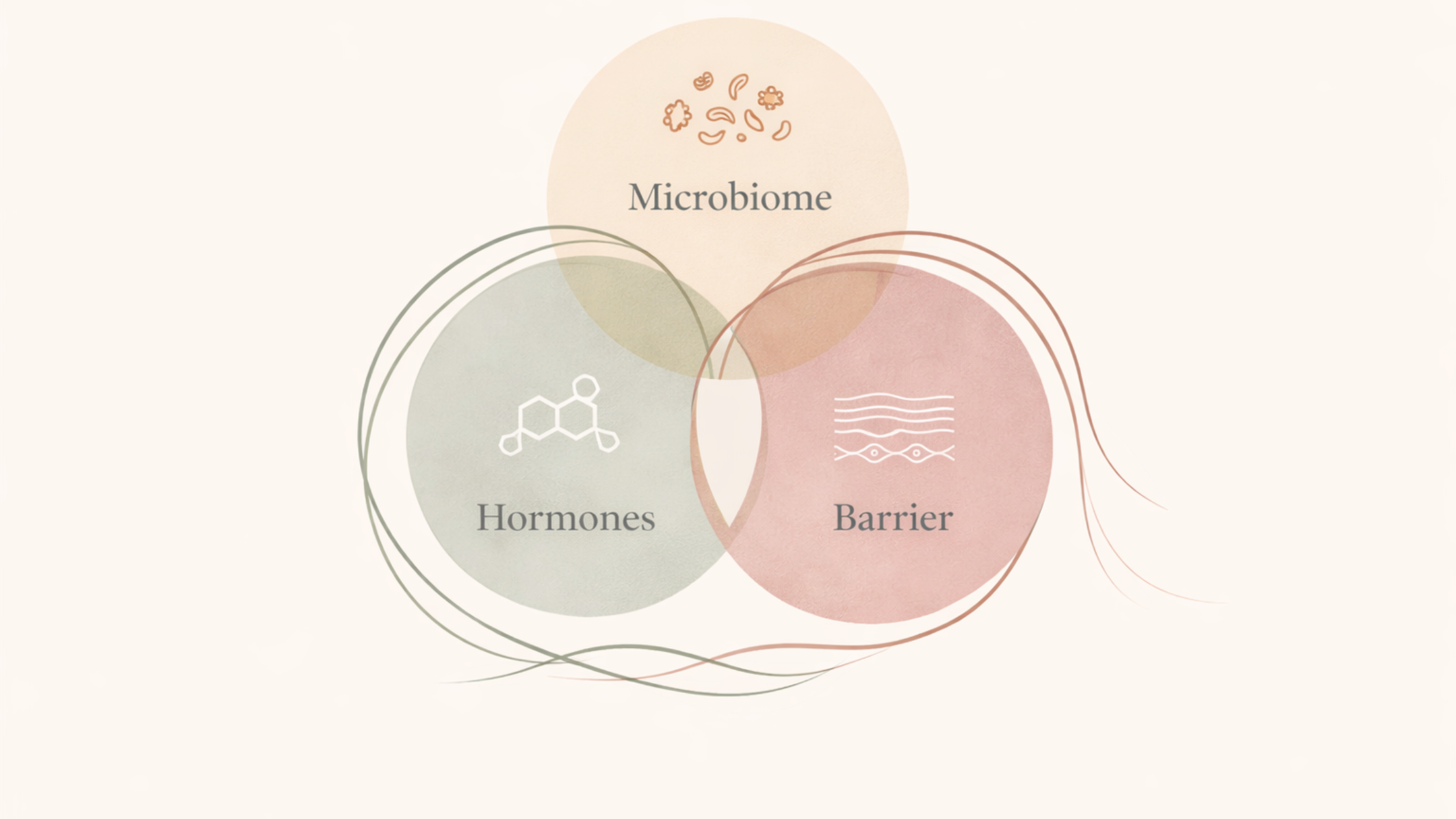
If your skin has changed dramatically during perimenopause or menopause - becoming dry, sensitive, reactive, or just fundamentally different - you're experiencing something far more complex than simple "ageing". There's a fascinating three-way connection happening between your hormones, your skin's microbiome, and your barrier function that explains why your skin feels like it belongs to someone else. Understanding this relationship changes everything about how you care for your skin during this transition.
The Triple Connection: Hormones, Microbiome, and Your Barrier
Here's what's actually happening beneath the surface of your changing skin during menopause, and why it matters more than you might think.
What Happens to Your Skin During Menopause
When oestrogen levels decline during perimenopause and menopause, your skin doesn't just "age faster". It undergoes specific, measurable changes that affect how it functions.
Research shows that skin collagen decreases by approximately 30% in the first five years after menopause. Even more tellingly, in the years that follow, skin thickness reduces by about 1% and collagen content by 2% each year.
But collagen loss is only part of the story. Oestrogen also helps your skin produce and retain moisture by supporting hyaluronic acid levels and maintaining your skin's protective barrier. When oestrogen drops, so does your skin's ability to hold onto moisture and protect itself effectively.
The result? Skin that feels fundamentally different - not just drier, but more vulnerable, more reactive, and less resilient than it used to be.
Your Skin Microbiome Changes During Menopause Too
Here's where it gets really interesting. Your skin isn't just dealing with hormonal changes - your skin's entire bacterial ecosystem is shifting as well.
Your skin is home to trillions of bacteria - and before you recoil, these are the good kind. They're like a protective army living on your skin's surface, helping to keep it healthy, balanced, and protected.
During menopause, this bacterial community changes. Research shows that some of the most helpful bacteria - particularly ones that produce protective fatty acids and help maintain your skin's natural pH balance - start to decline. Meanwhile, other bacterial species increase to fill the gaps.
Think of it like a garden where your favourite plants start thinning out, and different varieties naturally take their place. It's not necessarily harmful, but it does mean your skin's ecosystem is adapting to new conditions. And that adaptation period can leave your skin feeling more sensitive and reactive whilst everything rebalances.
The Barrier Breakdown During Menopause
Now combine these two factors - declining oestrogen and a shifting microbiome - and you get the third piece of the puzzle: a compromised skin barrier.
Research shows that oestrogen has a protective effect on your skin barrier. When oestrogen levels drop during menopause, that protection disappears.
The result? Your barrier becomes more "leaky" - moisture escapes more easily, irritants can penetrate more readily, and your skin becomes increasingly reactive to products it once tolerated beautifully.
Is your skin in the middle of this shift?
Unsure if your barrier is struggling or if your microbiome is out of balance? Take our 60-second Skin in Transition Audit to find your personalized ritual. Start My Audit
Why This Triple Connection Matters for Your Skincare During Menopause
Understanding this three-way relationship between hormones, microbiome, and barrier completely changes how you should approach skincare during menopause and perimenopause.
The Domino Effect of Menopause on Skin
Think of declining oestrogen as the first domino. It triggers a cascade:
- Less natural oil production - your skin becomes drier
- Reduced collagen and moisture-retaining compounds - your skin becomes thinner and loses plumpness
- Weakened barrier function - your skin becomes more permeable and less protective
- Shifted microbiome composition - your bacterial balance changes
- Increased sensitivity - your skin becomes more reactive to products and environment
- Slower healing - your skin takes longer to recover from irritation
Each change triggers the next, creating a cascade effect that explains why your skin feels so dramatically different during this transition - and why simply adding more products rarely helps.
"When I went through my own surgical menopause in my early 40s, I felt betrayed by my skin. It didn't just feel dry; it felt like it had forgotten how to be skin. That’s why I focus so heavily on the microbiome - it's about helping your skin remember how to protect itself." Gemma
Why Your Old Skincare Routine Stops Working During Menopause
This is why products you've used for years suddenly feel "wrong" during perimenopause or menopause. Your skin's needs have fundamentally changed at multiple levels:
Your barrier needs different support. Where you once needed light hydration, you now need serious lipid support to compensate for reduced oil production and maintain barrier integrity.
Your microbiome needs gentler treatment. As your bacterial ecosystem adapts, harsh cleansers and aggressive treatments can disrupt the delicate rebalancing process, leading to increased sensitivity and reactivity.
Your moisture retention is compromised. With less hyaluronic acid and a weaker barrier, your skin needs help both attracting moisture and sealing it in - one without the other simply doesn't work anymore.
What Your Menopausal Skin Actually Needs Now
Given this complex triple connection, what actually helps during menopause? The answer is simpler than you might think, but it requires a shift in perspective.
Support, Don't Fight Your Changing Skin
The key is supporting your skin through these menopausal changes rather than trying to force it back to how it was. Your skin isn't broken - it's adapting to new hormonal circumstances. Your job is to provide what it can no longer produce as abundantly on its own.
Lipid-Rich Support for Your Menopausal Skin Barrier
Since oestrogen decline reduces your skin's natural oil production, providing external lipids becomes crucial during menopause. This is where quality facial oils become genuinely therapeutic, not just cosmetic.
Your barrier is made of lipids. When you apply oils rich in the same essential fatty acids your skin naturally contains - omega-3s, omega-6s, and omega-9s - you're providing the building blocks your barrier needs to maintain its integrity despite lower oestrogen levels.
Learn more about how facial oils support barrier repair during menopause.
Key ingredients that help menopausal skin:
Rosehip oil is particularly valuable during menopause because it provides both essential fatty acids for barrier support and natural vitamin A to support skin renewal - all without the irritation that synthetic retinoids can cause on sensitised menopausal skin.
Argan oil delivers vitamin E and fatty acids that support barrier repair whilst providing anti-inflammatory benefits - crucial when your skin has become more reactive during this hormonal transition.
Pomegranate seed oil offers antioxidant protection during this vulnerable transition, shielding your skin whilst it adapts to new hormonal levels.
Sweet almond oil is beautifully soothing and helps seal in moisture - essential when your barrier has become more permeable.
Gemma’s Recommendation: The Nourishing Facial Oil
I formulated this oil to be the 'seal' for a leaking barrier. It contains the exact blend of unrefined Rosehip, Argan, and Pomegranate oils we’ve discussed, providing the lipids your skin can no longer produce abundantly on its own.
With a calming heart of Lavender, Frankincense, and Rose, it doesn't just repair the barrier - it quiets the 'heat' and reactivity of hormonal transitions.
Shop the Nourishing Facial Oil
Gentle, Microbiome-Friendly Cleansing for Menopausal Skin
Your shifting microbiome during menopause needs gentler treatment than ever. Harsh cleansers that strip your skin don't just remove dirt - they disrupt the delicate microbial rebalancing process happening on your skin.
Choose cleansers that clean without stripping, supporting your skin's natural pH and bacterial ecosystem rather than disrupting it. Your skin's bacteria are adapting to new circumstances; aggressive cleansing only makes this transition harder.
Moisture Support at Multiple Levels
With reduced natural moisture production and a more permeable barrier during menopause, your skin needs help both attracting and retaining hydration.
Humectants draw moisture in, but without adequate lipids to seal it in, that moisture simply evaporates through your compromised barrier. This is why oils become so crucial during menopause - they provide the seal your barrier can no longer maintain on its own.
Anti-Inflammatory Support for Reactive Menopausal Skin
As your microbiome shifts and your barrier weakens during menopause, your skin becomes more prone to inflammation and reactivity. Supporting your skin with gentle, naturally anti-inflammatory ingredients helps keep sensitivity under control whilst everything rebalances.
Ingredients like lavender, frankincense, and rose aren't just pleasant additions - they provide genuine anti-inflammatory support that sensitised menopausal skin genuinely benefits from.
What Doesn't Help Menopausal Skin (And Why)
Let's be honest about what's not useful during this hormonal transition.
Aggressive "Anti-Ageing" Treatments During Menopause
The skincare industry loves to sell the idea that you need to "fight" ageing with increasingly aggressive treatments. But when your barrier is compromised and your microbiome is in flux during menopause, aggressive treatments often backfire spectacularly.
Strong acids, high-concentration retinoids, and harsh mechanical or chemical exfoliation can all damage your already vulnerable barrier further, disrupt your adapting microbiome, and trigger more sensitivity rather than less.
Products That Strip or Dry Menopausal Skin
Anything that leaves your skin feeling "squeaky clean" is stripping away the lipids your barrier desperately needs during menopause. Foaming cleansers, harsh toners, and astringent products all work against what your skin is trying to do during this transition.
Complicated Multi-Step Routines for Menopausal Skin
When your barrier is compromised during menopause, less is genuinely more. Every additional product is another potential irritant, another ingredient your sensitised skin might react to, another disruption to your microbiome.
The most effective menopause skincare is often the simplest: gentle cleansing, lipid-rich support, and protection. That's it.
The Role of Internal Support During Menopause
Whilst topical skincare is important during menopause, what you do internally matters too for this hormonal transition.
Omega-3 Fatty Acids
Research suggests that gut bacteria can influence hormone metabolism. Supporting your gut health with omega-3-rich foods (fatty fish, flaxseeds, walnuts) provides benefits that extend to your skin during menopause.
Omega-3s also support barrier function directly by providing the fatty acids your skin uses to maintain its protective lipid layers - especially important when natural production has declined.
Hydration During Menopause
As your skin loses its ability to retain moisture efficiently during menopause, drinking adequate water becomes more important, not less. You're compensating for reduced hyaluronic acid and a more permeable barrier.
Stress Management
Stress impacts both your hormones and your microbiome. During a period when both are already in flux during menopause, managing stress becomes genuinely important for skin health, not just general wellbeing.
Phytoestrogens
Some research suggests that plant-based oestrogens from foods like soy, flaxseeds, and legumes may provide gentle hormonal support during menopause, though effects are subtle and individual. They won't replace your natural oestrogen, but they may help support your skin during this transition.
Men's Skin and Hormonal Changes
Whilst this blog focuses primarily on menopause, it's worth noting that men experience hormonal shifts too, and these affect their skin in similar ways.
As testosterone levels naturally decline with age, men's skin also produces less oil, becomes thinner, and experiences barrier function changes. The microbiome adapts to these hormonal shifts just as it does in women experiencing menopause.
The principles of supporting barrier function, respecting the microbiome, and providing lipid-rich support apply equally to ageing male skin, even though the hormonal mechanisms differ.
The Timeline: What to Expect During Menopause
Understanding the timeline of these changes helps you approach them with patience rather than panic.
Perimenopause (Usually 40s)
This is when you first notice changes. Your oestrogen levels start fluctuating wildly rather than declining steadily, which can make your skin feel unpredictable. One week it's fine, the next it's reactive and uncomfortable.
Your microbiome begins shifting, and your barrier becomes less consistent. Products that worked beautifully might suddenly sting or irritate.
Early Menopause (Usually Around 50)
The first few years after your periods stop are when the most dramatic changes occur. Research shows that skin collagen can decrease by as much as 30% in the first five years after menopause.
Your microbiome continues adapting to permanently lower oestrogen levels, and your barrier settles into a new, more vulnerable baseline.
This is when supporting your skin becomes most crucial - you're helping it navigate the biggest transition it will experience.
Post-Menopause (5+ Years After)
After the initial dramatic shifts, changes continue but at a slower pace. Skin thickness reduces by about 1% and collagen content by 2% each year, but your skin has largely adapted to its new hormonal environment.
With good support - barrier-protective skincare, microbiome-friendly practices, and internal support - your skin can be healthy, comfortable, and resilient at this stage. It will be different from your pre-menopausal skin, but "different" doesn't mean "worse" when you understand and support what it needs.
A Different Approach to Menopausal Skin
The conventional narrative around menopausal skin is all about loss - lost collagen, lost firmness, lost moisture, lost youth. But understanding the hormones-microbiome-barrier connection reveals a different story.
Your skin isn't failing during menopause. It's adapting to new circumstances with remarkable intelligence. Your microbiome is rebalancing to function optimally with different hormone levels. Your barrier is adjusting its structure to work with reduced lipid production. Your skin is doing exactly what it's designed to do - respond and adapt.
Your job isn't to "fight" these changes with increasingly aggressive treatments. It's to support your skin through this transition by providing what it can no longer produce as abundantly: lipids for your barrier, gentle support for your microbiome, and time for everything to rebalance.
The Puremess Approach to Menopausal Skin
This understanding of the hormones-microbiome-barrier connection is exactly why Puremess exists. Our formulations are designed specifically to support skin through these kinds of transitions:
Gentle cleansing that respects your microbiome rather than disrupting it during this vulnerable time.
Lipid-rich support from unrefined plant oils that provide the essential fatty acids your barrier needs when natural production has declined.
Anti-inflammatory botanicals like lavender, frankincense, and rose that support sensitised skin through this vulnerable period.
Simple, focused formulations that don't overwhelm already reactive skin with unnecessary ingredients.
We're not trying to "turn back time" or "fight ageing". We're supporting your skin's natural intelligence as it adapts to new circumstances during menopause and beyond.
Frequently Asked Questions About Menopause and Skin Microbiome
How does menopause affect skin microbiome?
Menopause changes your skin microbiome by reducing beneficial bacteria whilst increasing overall bacterial diversity. Research shows that specific protective bacteria decline during menopause, whilst other species increase to fill the gaps. This occurs because declining oestrogen affects the environment these bacteria live in, forcing your microbiome to adapt to new hormonal conditions.
Why does my skin barrier get worse during menopause?
Oestrogen has a protective effect on your skin barrier. When oestrogen declines during menopause, your skin produces less natural oil, less collagen, and less hyaluronic acid - all components crucial for barrier function. Research shows that skin thickness reduces by about 1% and collagen content by 2% each year during post-menopause, making your barrier increasingly vulnerable.
Can you repair your skin barrier during menopause?
Yes, absolutely. Whilst you can't restore oestrogen levels through skincare alone, you can support your barrier during menopause by providing the lipids and essential fatty acids it needs externally. Facial oils rich in omega-3, omega-6, and omega-9 fatty acids help compensate for reduced natural oil production, whilst gentle, microbiome-friendly products support your skin's adaptation to new hormonal circumstances.
How long do menopausal skin changes take?
The most dramatic skin changes during menopause occur in the first five years, when collagen can decrease by as much as 30%. However, adaptation continues throughout post-menopause at a slower pace. With proper support, your skin typically adapts to its new hormonal environment within 2-3 years, though individual timelines vary considerably.
What ingredients help menopausal skin most?
Essential fatty acids from plant oils (rosehip, argan, sweet almond) support barrier function during menopause, whilst anti-inflammatory botanicals (lavender, frankincense, rose) help manage increased sensitivity. Ingredients that support your microbiome whilst providing lipid-rich barrier support are most beneficial. Avoid harsh exfoliants, stripping cleansers, and aggressive treatments that disrupt your already vulnerable barrier and adapting microbiome.
Does everyone's skin microbiome change during menopause?
Yes, hormonal changes during menopause influence the composition and function of the microbiome in various areas including skin. However, the degree and specific changes vary individually based on genetics, lifestyle, environment, and skincare practices. Supporting your microbiome with gentle products helps this transition happen more smoothly during perimenopause and menopause.
What's the difference between perimenopause and menopause for skin?
Perimenopause (typically your 40s) involves fluctuating oestrogen levels, making your skin unpredictable - fine one week, reactive the next. Menopause (after periods stop) brings more consistent but permanently lower oestrogen, causing steady changes. The first five years of menopause typically see the most dramatic skin changes, with things stabilising thereafter.
Your Transition Doesn't Have to Be a Struggle.
If you're ready to move from 'reactive' to 'resilient,' I recommend starting with our Hormonal Glow Bundle. It’s the exact system I used to rebuild my own barrier. View the Bundle
Related Reading:
- How to Repair a Damaged Skin Barrier: 5 Signs Your Skincare Is Too Harsh
- Facial Oils for Barrier Repair: Winter Skin Guide
- Natural Skincare for Mature Skin: What Actually Works
Your skin isn't broken during menopause. It's adapting. Support it well, and it will reward you with healthy resilience through this transition and beyond.

Written by Gemma Cockrell